The IEC standard for cables is the published technical reference that fixes how a cable is constructed, what materials go inside, and which tests it must pass before leaving the factory. For a tender writer, a procurement engineer, or anyone signing off on factory acceptance, the practical question is which publication applies to the cable on the drawing, which edition is current, and what compliance evidence the contract should demand. This guide answers those three questions for the standards active in 2026 procurement, and shows where specifications most often go wrong.
Which IEC Standard Do I Need?
The right reference depends on where the cable goes, what it carries, and what fire risk applies. The decision table below maps the most common procurement scenarios to the publications that govern them.
| Application | Cable Type | IEC Construction Standard | Fire Standard | Documents to Request |
|---|---|---|---|---|
| LV distribution (0.6/1 kV) | XLPE/PVC, unarmored or armored | IEC 60502-1:2021 + IEC 60228:2023 | IEC 60332-1-2:2025 minimum | Type test report, routine test record, CoC |
| MV distribution (6–30 kV) | XLPE or EPR with screens | IEC 60502-2:2014+AMD1:2024 | IEC 60332-3:2018, IEC 60331-4:2024 for life-safety | PD test report, type test report, drum marking proof |
| Building wiring | PVC single-core | IEC 60227-3:2024 | IEC 60332-1-2:2025 | Routine test record, sheath marking sample |
| Photovoltaic DC side | Tinned Cu, cross-linked elastomer | IEC 62930:2017 (or EN 50618) | IEC 60332-1-2:2025 plus UV/ozone | 25-year ageing data, type test report |
| Shipboard and offshore | Mud-resistant, halogen-free | IEC 60092-350:2020 / 353:2024 / 354:2014 | IEC 60332-3 Cat A, IEC 61034 | Classification society approval (DNV, BV, ABS) |
| Data center / structured | Cat 6A or Cat 7 LAN | IEC 61156 series | IEC 60332-1-2:2025, LSZH sheath | Fluke channel test, performance certificate |
| Critical fire circuit | Mineral-insulated or FR-LSZH | IEC 60502 + IEC 60331-1/-2:2018 (LV), -4:2024 (MV) | IEC 60331 at ≥830°C, BS 6387 C/W/Z | Independent FR test report |
Construction Standards: IEC 60502 and IEC 60228
These two publications define everything inside the cable before any fire test applies. IEC 60502 sets the voltage class, insulation type, and screen design. IEC 60228 sets the conductor itself.
IEC 60502 Voltage Ranges and Parts
IEC 60502-1:2021 applies to low-voltage power cables rated 1 kV and 3 kV for distribution networks and industrial installations.
IEC 60502-2:2014+AMD1:2024 covers medium-voltage cables from 6 kV up to 30 kV.
IEC 60502-4:2023 specifies type tests for terminations and joints used at medium voltage.
IEC 60228 Conductor Classes
IEC 60228:2023 is the fourth edition, published 11 December 2023. It covers cross-sectional areas from 0.5 mm² to 3,500 mm² for copper, aluminum, and aluminum-alloy conductors.
The 2023 revision tightened maximum resistance for larger aluminum sizes. The 2,500 mm² limit dropped from 0.0127 Ω/km in the 2004 edition to 0.0119 Ω/km.
The standard organizes conductors into four classes by strand structure and flexibility. The table below pairs each class with its typical cable application.
| Class | Construction | Typical Use |
|---|---|---|
| 1 | Solid | Fixed wiring, smaller sections |
| 2 | Stranded | LV and MV fixed power, including steel-tape armored YJV22 cable |
| 5 | Flexible | Cords, control cables, and frequent movement |
| 6 | Extra flexible | Robotics, welding, drag chain |
Fire Performance: IEC 60332, 60331, 61034, and 60754
Four standards cover four different failure modes during a fire, and they are not interchangeable. The right combination depends on whether the priority is stopping the flame from spreading, keeping the circuit alive, keeping the smoke clear, or keeping the gases non-corrosive.

Flame Propagation Under IEC 60332
IEC 60332-1-2:2025 is the new second edition published in June 2025. It tests a single insulated cable mounted vertically against a 1 kW pre-mixed flame. The sample must self-extinguish, and the damaged length must stay within defined limits.
IEC 60332-3:2018 tests vertically bunched cables with more severe flame sources. Severity grades range from Category A/F as the heaviest fuel load down to Category D as the lightest. The bundled test reflects what cable trays, risers, and trenches actually face during a fire.
Circuit Integrity Under IEC 60331
IEC 60331-1:2018 evaluates cables larger than 20 mm at rated voltages up to 0.6/1.0 kV.
IEC 60331-2:2018 specifies cables 20 mm and smaller in the same voltage range.
IEC 60331-3:2018 covers cables in a metal enclosure.
All three apply fire plus mechanical shock at 830°C or higher.
IEC 60331-4:2024 is the new publication for medium voltage. It extends the same fire-plus-shock test to cables above 1 kV up to 30 kV, with conductor sizes up to 120 mm². Projects governed by UK rules sometimes layer BS 6387 Category C on top, which raises the temperature to 950°C for 180 minutes.
Smoke and Halogen Behavior
IEC 61034-2:2005+AMD1:2013+AMD2:2019 determines smoke density in a 3 m × 3 m × 3 m cubical chamber using a photometric system. Higher light transmission means lower smoke. Acceptance limits vary by project and are usually written above 60% light transmittance for low-smoke applications.
IEC 60754-1:2011+AMD1:2019 tests the total mass of halogen acid gas released during combustion.
IEC 60754-2:2011+AMD1:2019 measures the pH and conductivity of the resulting gas mixture. Standard LSZH acceptance is pH ≥ 4.3 and conductivity ≤ 10 µS/mm.
IEC Standards by Sector
Construction standards alone do not cover everything. Each sector layers additional IEC publications with very different priorities.

Power Cables Above 30 kV
IEC 60840:2020 (with Amendment 1:2023 and Corrigendum 1:2025) covers high-voltage cables from above 30 kV up to 150 kV. It adds tighter partial-discharge sensitivity, mandatory longitudinal water blocking, and accessory qualification at higher field stress. The 2023 amendment introduced a low-smoke halogen-free oversheath designated ST12.
For installation under utility rules such as SEC in the Gulf region, the construction standard is only half the answer, and the pulling, bending, and termination steps follow the rules summarized in the MV cable installation guide for SEC standards.
Photovoltaic Cables
IEC 62930:2017 applies to cables rated 1.5 kV DC for crystalline-silicon and thin-film PV arrays. It sets a continuous conductor temperature of 90°C and allows 120°C for cumulative use up to 20,000 hours over the cable life.
The target service life is at least 25 years under combined ultraviolet, ozone, and ammonia exposure.
Tinned copper is the default conductor because bare copper oxidizes under PV humidity. EN 50618 is the European equivalent often called up alongside IEC 62930 in international tenders. See the tinned copper PV and drag chain cable line for typical constructions.
Shipboard and Offshore Cables
IEC 60092-350:2020 determines general construction for shipboard and offshore power, control, and instrumentation cables up to 18/30 kV.
IEC 60092-353:2024 is the new fifth edition for cables rated 0.6/1 kV and 1.8/3 kV.
IEC 60092-354:2014 covers 6/10 kV to 18/30 kV. Marine sheaths must resist salt spray, fuel oil, and engine-room temperatures, and shipboard fire performance almost always combines IEC 60332-3 Category A with IEC 61034 and IEC 60754-2.
Structured Data Cables
Data cabling uses transmission-performance grading rather than voltage classes.
IEC 61156 quantifies twisted-pair cables. Category 5e supports 1 Gbps, Category 6 supports 10 Gbps over short runs, Category 6A supports 10 Gbps over a full 100 m channel, and higher Categories push the frequency further.
IEC 60794 addresses optical fiber cables and adds crush, tensile, and bending tests. Acceptance for both depends on channel-level Fluke testing, not just per-metre electrical checks. Most data center backbones use Cat 6 and Cat 7 communication cables for that reason.
Rubber and Heavy-Duty Cables
IEC 60245 covers rubber-insulated cables used in generators, cranes, and mining tools. The H07RN-F designation under IEC 60245-4 is the global default at 450/750 V for portable connections.
Abrasion resistance, oil resistance, and flexing endurance outrank flame propagation in this family. Choose the H07RN-F rubber cable range for harsh-environment construction.
Verifying IEC Compliance Before Procurement
The proof of compliance matters as much as the standard quoted on the drawing.
Documents That Should Be on File
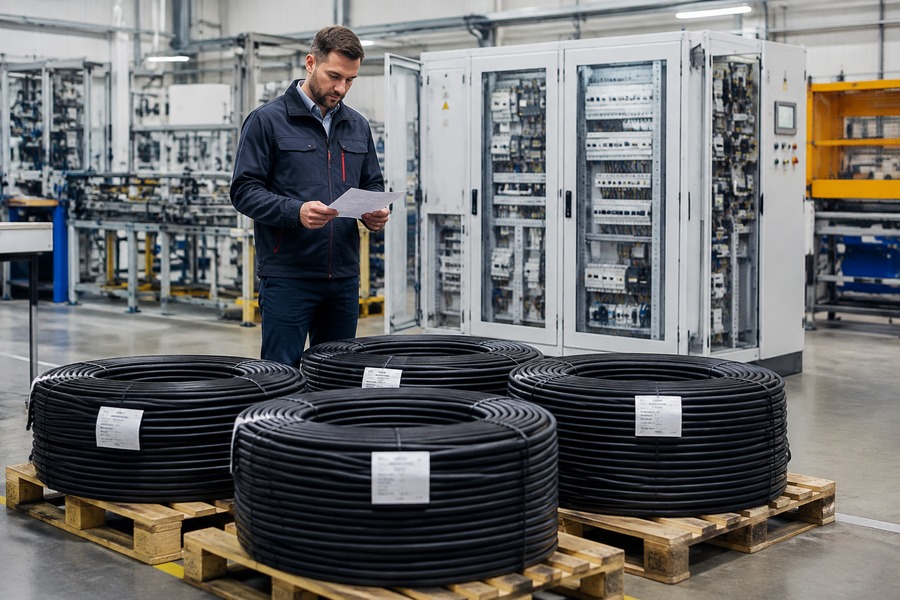
A complete supplier package usually contains a type test report from an accredited laboratory, a routine test record for every drum, and a declaration of performance tied to the named edition. Reports from KEMA, VDE, or CNAS carry international weight and reduce the need for site re-testing.
Marking and Edition Discipline
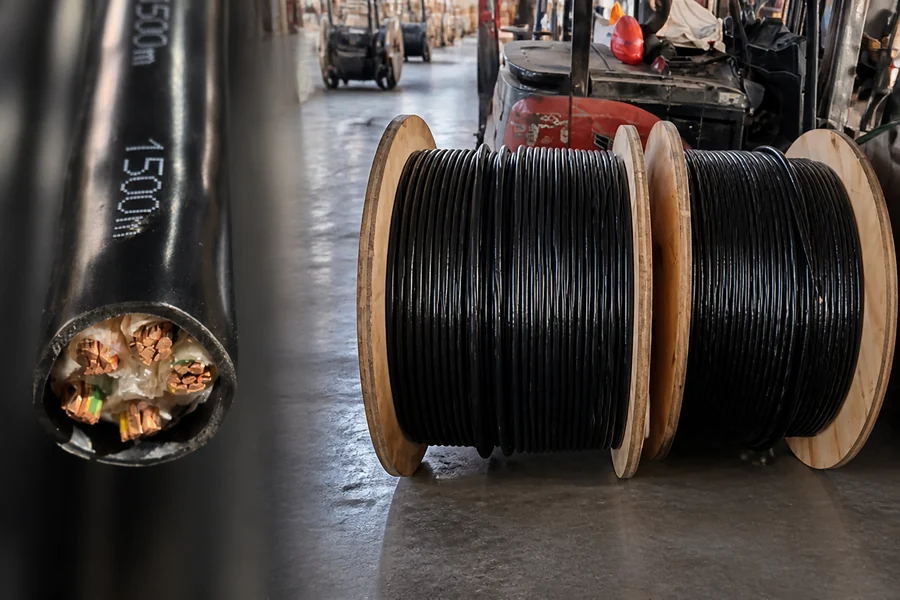
Outer-sheath marking under IEC 60502 must repeat at least every 500 mm and show the manufacturer, conductor section, voltage class, and edition reference.
Drum tags carry the drum number, metre mark, gross and net weight, production date, and reel-off direction.
Quoting “IEC 60228:2023 Class 2 Cu” or “IEC 60502-1:2021” stops older stock from being substituted at the last minute, and ground conductor sizing should still follow the project code as covered in the EGC ground wire sizing chart.
FAQs
What is the difference between IEC 60502 and IEC 60228?
IEC 60502 covers the whole cable, including insulation, dimensions, voltage rating, and test methods. IEC 60228 covers only the conductor, defining cross-section, class, and resistance. IEC 60502 references IEC 60228 when specifying the conductor inside the cable.
What is the IEC standard for cables used in low-voltage distribution?
IEC 60502-1:2021 governs cables rated 1 kV and 3 kV. It defines construction, dimensions, routine, and type tests. The 0.6/1 kV class is the global default for industrial and building distribution.
Which IEC cable standard defines conductor sizes?
IEC 60228:2023 specifies nominal conductor cross-sections from 0.5 mm² to 3 500 mm² across four classes covering solid, stranded, flexible, and extra-flexible conductors. It also defines maximum DC resistance values at 20°C.
How does the IEC standard for cables address fire safety?
IEC 60332-1-2:2025 and 60332-3:2018 cover flame propagation. IEC 60331:2018 covers LV circuit integrity at 830°C, and IEC 60331-4:2024 covers MV. IEC 61034 covers smoke density. IEC 60754 covers halogen acid gas.
Is IEC 60502 mandatory for medium-voltage power cable procurement?
IEC 60502-2:2014 with Amendment 1:2024 is the dominant MV reference outside North America. Utility tenders in Europe, Asia, Africa, and the Middle East routinely require it. Some markets accept national equivalents such as VDE 0276 or GB/T 12706.
What documents prove IEC cable compliance?
A type test report from an accredited laboratory, a batch routine test record, a declaration of performance, and a certificate of conformity referencing the named IEC edition. Buyers should also confirm that the sheath marking matches the documents.
Action-Oriented Conclusion
Three steps close the gap between an IEC reference on paper and a compliant cable on site.
First, name the part and the edition on every spec line. Writing “IEC 60502-2:2014+AMD1:2024” tells the supplier exactly which test methods apply, while “IEC 60502” alone leaves room for the wrong edition.
Second, pair the construction standard with the fire test that the project actually needs. The right combination is different for a hospital basement, a residential garage, and a ship engine room. The decision table earlier in this guide is the working checklist.
Third, ask for documents at the purchase order stage, not on delivery day. Type test reports from accredited labs cannot be issued retroactively, and demanding them up front filters out suppliers that lack genuine compliance.
Sources & References
- IEC Standards